
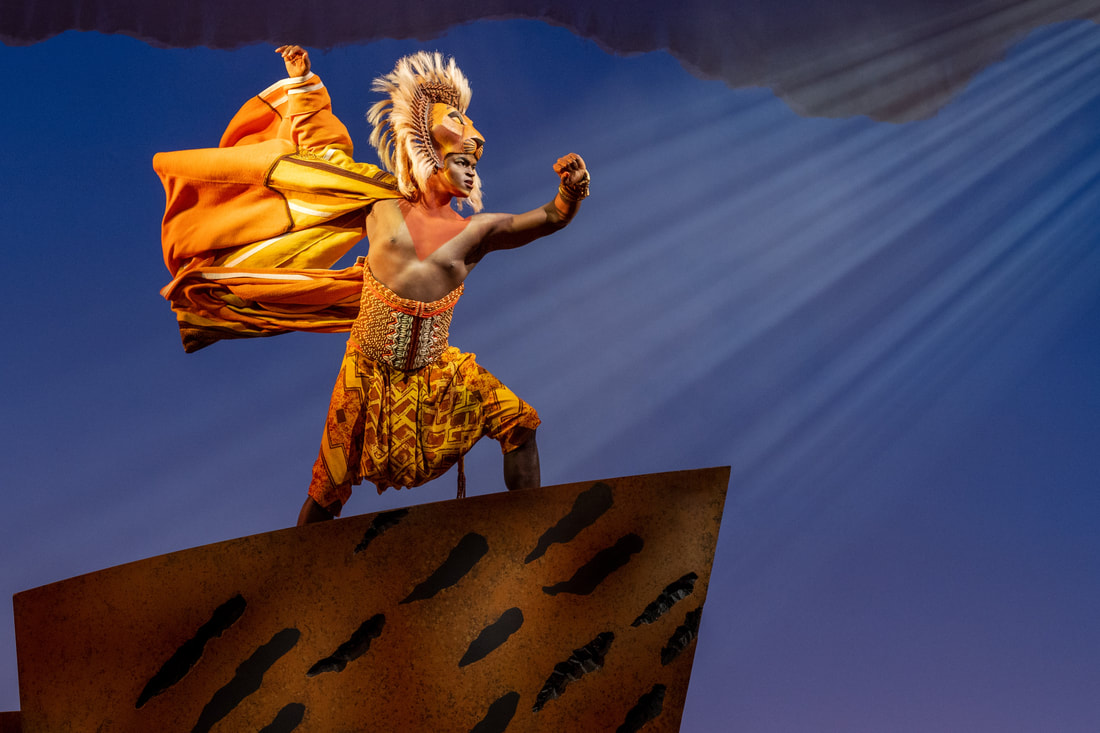
 Darian Sanders as Simba. The Lion King North American Tour. ©Disney. Photo by Deen van Meer. In 1994, Disney’s animated classic, The Lion King, took the world by storm. Audiences of all ages were captivated by the tale of a young lion named Simba and his long, tumultuous journey to becoming the king he was always meant to be. The sweeping, beautifully drawn Pride Lands of Tanzania and the vibrant, colorful animal characters came to breathtaking life in animated form, but, even more amazingly, they weren’t confined there. The musical version, directed by Julie Taymor and onstage now at the Durham Performing Arts Center (DPAC), brings all the wonder of the film to the stage. Featuring a book by Roger Allers and Irene Mecchi, music and lyrics by Elton John and Tim Rice, and additional music and lyrics by Lebo M, Mark Mancina, Jay Rifkin, Julie Taymor, and Hans Zimmer, it’s one of those productions you have to see to believe. With larger-than-life puppets (more than 200 are used in the production), gorgeous choreography, and incredible props and special effects, it’s a thrilling spectacle that awakens the child inside every viewer. The production’s visual appeal, however, is just one of its many strengths. It’s also a touching and surprisingly relatable coming-of-age story packed with powerhouse performances. At the May 16th performance, viewers were treated to an adorable Bryce Christian Thompson as Young Simba. From his precious dimples and bright smile to his incredible dancing skills and vibrant spirit, he makes for a perfect, playful Young Simba. Joined by an equally endearing Ritisha Chakraborty as Young Nala, the duo immediately starts getting into mischief. Luckily, Simba’s father, Mufasa, portrayed with tender firmness by Gerald Ramsey, is there to help guide Young Simba. Sharing an incredible, sweet chemistry, Ramsey and Thompson are fully believable as father and son, giving the story even more of an emotional impact. Speaking of believable, Peter Hargrave is wonderfully menacing as the show’s villain, Mufasa’s jealous and power-hungry brother, Scar. Alternating between sourly funny and downright scary, Hargrave slinks, snarls, and seethes to perfection. He is joined by his equally frightening minions, a pack of dumb-but-funny hyenas. The dumbest of all, Ed, portrayed by a slobbering Robbie Swift, generates the most laughs . . . at least until Simba’s second-act pals, Timon, played by a hilarious, purposefully hokey Nick Cordileone, and Pumbaa, a gassy warthog portrayed with sweet stupidity by John E. Brady, arrive on the scene. While most viewers are probably familiar with the story and with how Timon and Pumbaa come into play, for the sake of avoiding spoilers, suffice it to say that these two characters, along with the help of a lovable Rafiki (Mukelisiwe Goba), lead Simba, portrayed in his adult form by a strapping Darian Sanders, back onto the right path. Along the way, there are, of course, incredible musical numbers, including the beloved “I Just Can’t Wait to Be King,” “Hakuna Matata,” and countless others. And, who could forget the awe of the opening “Circle of Life” number, in which massive, enthralling “animals” parade down the aisles? As if that wasn’t enough, Garth Fagan’s choreography steals many a scene. From leaping gazelles to stealthy lionesses, he creates an energizing, flowing sense of movement that perfectly complements the story’s themes. Likewise, amazing set pieces and mood-setting lighting effects help bring the tale together. Much like the circle of life itself, each element serves a clear purpose. Not a single thing is done without thought, and the result is a perfect, masterful production. It’s difficult to imagine a harder-to-execute musical, and yet, there’s not a flaw to be found. Viewers who want to feel energized and inspired should rush out to see The Lion King at DPAC. Always a treat and forever awe-inducing, it’s pure magic from the first scene to the last. -Susie Potter
0 Comments
|
TAR
We love the arts. We write about them. Founded 2018. Categories
All
Archives
January 2024
|
 RSS Feed